Posts

Cost of Capital

Image
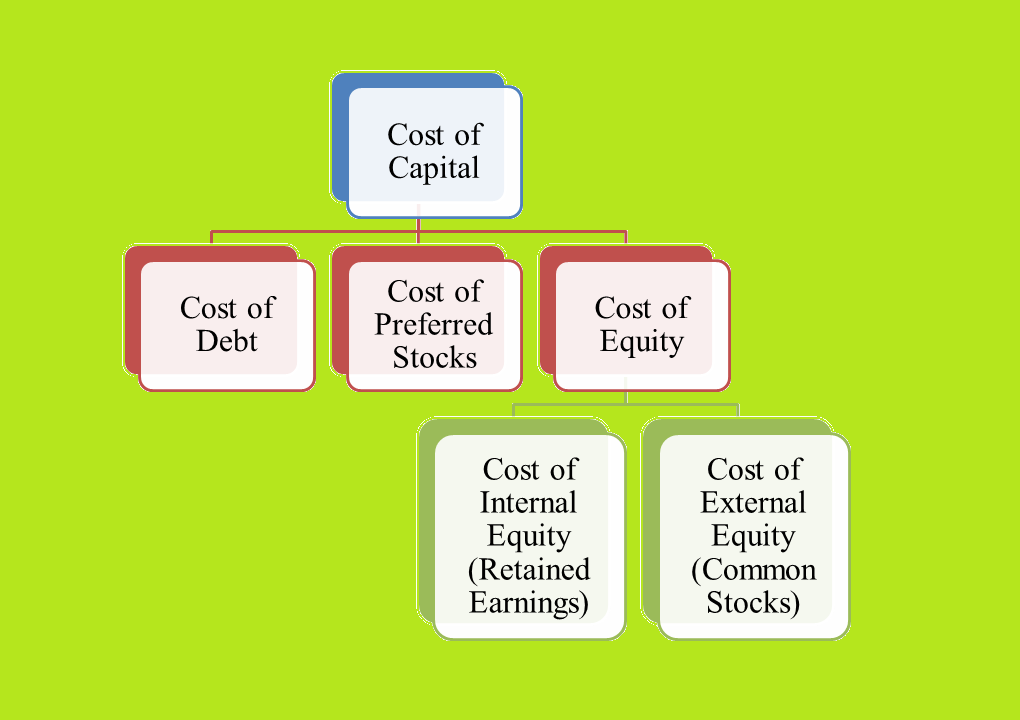
Meaning of Cost of Capital Capital is the money that is required for business day-to-day operation and future growth. There are mainly four types of shareholder's capital includes common stock, preferred stocks, debt capital (bonds and debentures) and retained earnings. Cost of capital is the weighted average cost of various sources of fund like equity and debt. It is the minimum rate of return that a company expects to earn from its investment in order to maximize the value of the firm in the market. Components of Cost of Capital Generally, there are three types of financing used by the firm include debt, preferred stock and equity. The equity further two types includes internal equity (common stock) and external equity (retained earnings). So based on these sources of fund, there are mainly four components comes for calculating cost of capital of the firm described as bellows: Cost of Debt (Kdt): It is the effective interest rate that a company is paid on its debts. It...

Valuation of Security

Image
Meaning of Assets  Assets are the items or properties owned by person or company having value to meet various financial needs. The assets can be classified into three categories. They are Based on Convertibility: The assets that can be whether converted into cash quickly or not. It could be current (cash and cash equivalents assets) and fixed (real) assets. Based on Physical Existence: The assets that can be seen and having physical appearances. It could be tangible and intangible assets. Based on Usages: The assets having various business purposes. It could be operating and non-operating assets. As per the first category of division of assets, can be seen as in the presented table bellows: Table: Asset Classification Note: Financial Assets often considers as marketable securities that is one of the component of current assets. Concept of Financial Securities Security is a financial instrument or financial asset that can be traded i.e. bought or sold. The financial asse...

Time value of Money

Image
Concept of Time Value of Money   Finance is an art and science of money management. The time value of money is one of the best concept in fiance. Money has time value. For example, if you're invested Rs. 100 today for a next five years @ 10% p.a. the future value will not be same as today.  The time value of the money is a concept that present worth of money is more than same amount in the future. In short, receiving money Today is preferable than receiving same money in the future. It has happened due to following three reasons: Reinvestment opportunity: Money received today can be reinvested to get further return. Inflation: Inflation brings upward change in the price level with the passes of time.  Sacrifice of Present Consumption:  For making an investment a person must have saving habit by sacrificing his/her present consumption pattern so that they can easily invest to get better and further return. Components of Time Value of Money In this topic we have to u...

Dopont Model Analysis

Image
Introduction Du-pont is very useful and helpful tool for manager, investors, and analyst that is created in 1920s by American Chemical Manufacturing Giant, Dupont Corporation for the purpose analyzing operation efficiency in the organization. Du-pont analysis is an extended examination of Return on Equity (ROE) of a company which analysis Net Profit Margin, Assets Turnover, and Financial Leverage or Equity Multiplier Ratio. In simple words, it breaks down the ROE to analyze how corporate can increase the return for their shareholders. Net Profit Margin is related to Profitability Ratio Total Assets Turnover is related to Efficiency Ratio Equity Multiplier is related to Leverage Ratio Derivation of Du-pont Model  Components of Du-Pont Analysis The following are the five components of Du-Pont Analysis listed as bellows: Net profit Margin Ratio: It compares total net profit to total sales. It measures the profitability ratio of the company. Total Assets Turnover Ratio: It compares ...

Concept & Measurement of Net Worth

Image
Introduction Net worth is the remain assets value claim by shareholder's after discharging all the liabilities i.e. long-term and short term liabilities. Net worth is what is owns minus what is owed. Net worth is total assets (include both financial and non-financial assets) minus any total debts you owe. It acts as an indicator of your financial health. Types of Net Worth Basically there are two types of net worth explained as bellows: Personal Net worth: Personal net worth is the amount of a person that is calculated by subtracting total liabilities from total assets. The assets include bank deposit, investment in stock, real estate property, gold, insurance etc. While liabilities include home loan, mortgage loan, car loan, credit card loan, personal loan etc. Business Net Worth: It is also known as book-value of company or shareholder's equity. Business prepare the balance sheet which is also known as net worth statement. The business net worth or shareholder's equity...